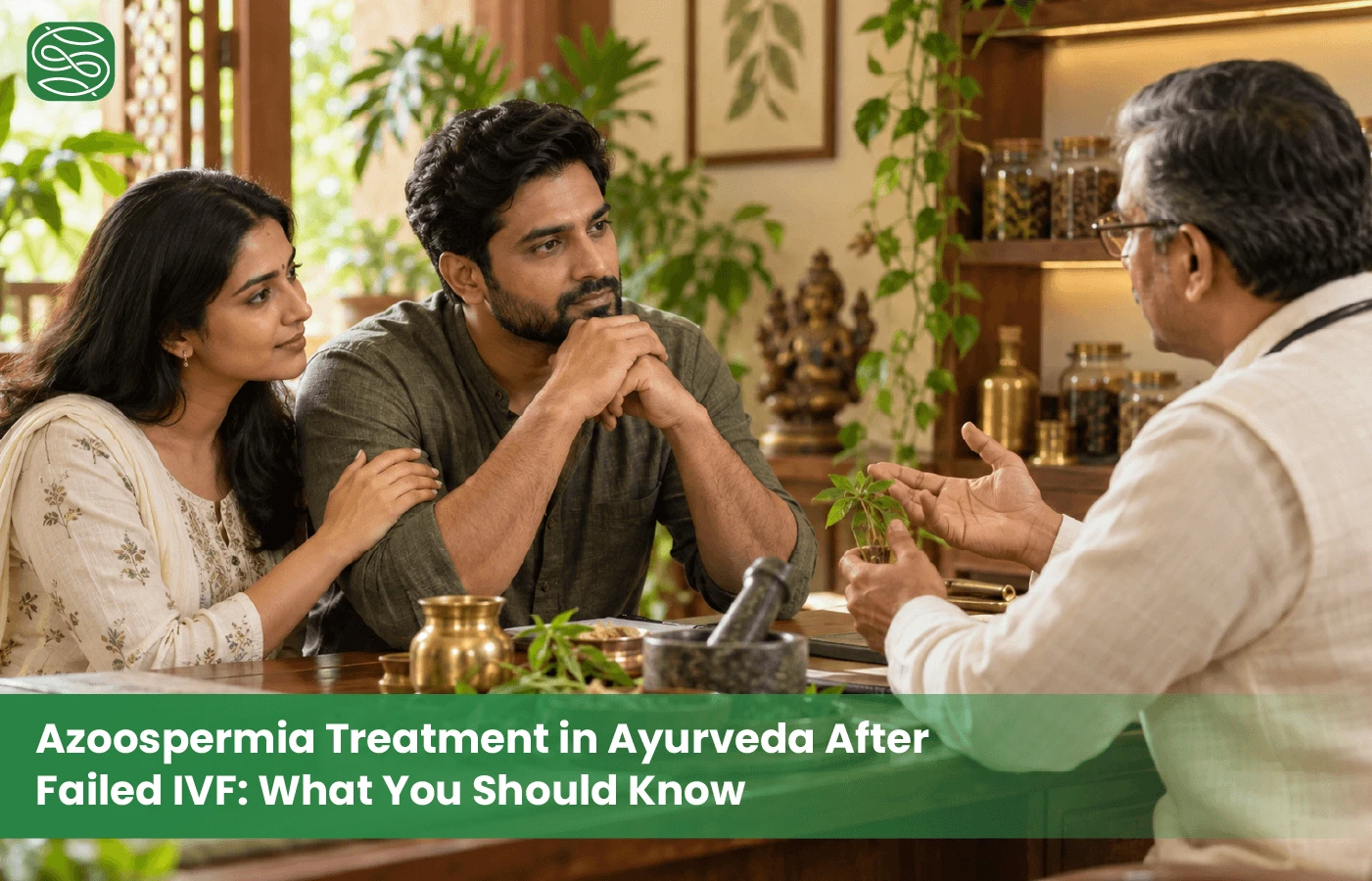
In Ayurveda, azoospermia is described under Shukra Kshaya or Shukra Dushti. Treatment commonly combines Vajikarana Chikitsa, Panchakarma, herbal support, and lifestyle correction.
Core Treatment Plan
- 1. Vajikarana Chikitsa (Fertility Therapy): Uses herbs such as Ashwagandha, Kapikachhu, Safed Musli, and Shilajit to support reproductive health and vitality.
- 2. Panchakarma (Detoxification): Therapies such as Virechana, Basti, and Uttara Basti are selected based on the individual’s condition and constitution.
- 3. Diet & Lifestyle Adjustments: Focuses on nutritious food, adequate sleep, stress management, and reducing factors such as alcohol, tobacco, and excessive heat.
Medically reviewed by Dr. Mruthyunjaya, Fertility Specialist & Ayurvedic Physician, Shathayu Ayurveda
A failed IVF cycle can feel like your world is collapsing. After years of fertility treatments, medications, tests, financial strain, and losing hopes, the emotional toll is immense. But here’s the truth: a failed IVF does not mean the end of your journey to parenthood.
Whether you’ve been diagnosed with Azoospermia, Teratozoospermia, Astheno-teratozoospermia, or another form of male factor infertility, you may still have a chance to father your own biological child with the right care, the right diagnosis, and a little more time.
Many men come to Ayurveda only after being advised to consider donor sperm, or after genetic testing has come back discouraging. Thanks to growing collaboration between modern reproductive medicine and Ayurvedic infertility care, there is real, evidence-informed hope for many of these men even after a failed IVF cycle.
A note on expertise: This article is reviewed by Dr. Mruthyunjaya, who specializes in integrating Ayurvedic fertility protocols with modern diagnostic reproductive medicine. His clinical approach at Shathayu Ayurveda emphasizes identifying which cases are likely to respond to Ayurvedic care and which need to proceed with assisted reproduction or donor options — rather than treating every case the same way.
Understanding Male Infertility: What Is Azoospermia?
Azoospermia is a condition where no sperm are present in the ejaculate. It’s one of the most challenging forms of male infertility, but it is not always irreversible.
Types of Azoospermia
- Obstructive Azoospermia (OA) — Sperm production is normal, but a physical blockage prevents sperm from appearing in the semen.
- Non-Obstructive Azoospermia (NOA) — Sperm production in the testes is reduced or absent, usually due to underlying hormonal or testicular issues.
Common Causes
- Genetic conditions (e.g., Klinefelter syndrome, Y-chromosome microdeletions)
- Hormonal imbalances (low FSH, LH, or testosterone)
- Obstructions (prior vasectomy, infection, congenital absence of the vas deferens)
- Testicular failure (following chemotherapy, radiation, or mumps orchitis)
Note: Genetic causes of azoospermia (such as Klinefelter syndrome or Y-chromosome microdeletions) are structural and are not reversed by any therapy. For these men, Ayurvedic care is best used to support general reproductive health alongside and clubbed with procedures like Micro-TESE and ICSI.
Azoospermia treatment in Ayurveda: Root Causes and Approach
In Ayurveda, male infertility is understood as an imbalance in the Tridoshas Vata, Pitta, and Kapha affecting the reproductive tissue, or Shukra Dhatu.
- Vata imbalance can disrupt the transport and release of sperm.
- Pitta imbalance affects the hormonal and metabolic processes needed for healthy sperm production.
- Kapha imbalance may contribute to blockages in the reproductive channels and reduced sperm quality.
Two classical concepts are especially relevant here: Shukra Kshaya (depletion of reproductive tissue) and Beejadosha(defective sperm quality) both of which parallel modern findings in semen analysis.
Diagnosis: Combining Modern and Ayurvedic Insights
Conventional diagnostics typically include:
- Semen analysis (a minimum of two tests to confirm azoospermia)
- Hormonal panel: FSH, LH, testosterone, prolactin
- Genetic testing: karyotyping, Y-chromosome microdeletion testing
- Imaging: scrotal or transrectal ultrasound (TRUS)
- Testicular biopsy, TESA, or PESA to check for sperm within the testicular tissue
Ayurvedic evaluation adds a complementary layer, assessing:
- Dosha imbalance
- Agni (digestive and metabolic strength)
- Srotas (channel) obstruction
- The health of Shukra Dhatu
- Overall vitality, or Ojas
Dr. Mruthyunjaya’s protocol at Shathayu Ayurveda begins with this combined diagnostic picture because knowing why sperm production has stalled determines which men are realistic candidates for natural improvement, and which should move forward with assisted retrieval techniques without delay.
IVF Failure Is Not the Final Word
Many couples turn to IVF with high hopes, especially when using ICSI (Intracytoplasmic Sperm Injection) for male infertility. IVF cycles can fail for several reasons:
- No sperm retrieved during ICSI
- Poor embryo quality or development
- Repeated implantation failure
Often, the underlying issue sperm quality, quantity, or an unaddressed hormonal imbalance was never resolved at its root. A failed cycle can be a diagnostic clue rather than a dead end.
A Second Chance: Ayurvedic Support for Azoospermia
At Shathayu Ayurveda, Dr. Mruthyunjaya has worked with many men diagnosed with azoospermia and other sperm quality issues, including some who had already gone through failed IVF cycles. For men whose azoospermia stems from reversible causes hormonal imbalance, inflammation, lifestyle factors, or mild obstruction personalized Ayurvedic care has, in a number of cases, supported measurable improvement in semen parameters over time.
How Azoospermia Treatment in Ayurveda Is Planned?
- 1. Panchakarma (Detoxification Therapy) Clears accumulated toxins, addresses inflammation, and prepares the body for deeper healing. Includes therapies like Virechana, Basti, Shirodhara, and Abhyanga.
- 2. Rasayana Therapy (Rejuvenation) Herbal formulations Ashwagandha, Kapikacchu, Safed Musli, Shatavari used to nourish reproductive tissue and support hormonal balance.
- 3. Vajikarana Chikitsa (Fertility Enhancement) A dedicated branch of Ayurveda focused on improving libido, vitality, and Shukra Dhatu quality.
- 4. Lifestyle and Diet Correction Individualized guidance on yoga, nutrition, sleep, and reducing exposures known to harm sperm health alcohol, heat, and chronic stress.
Can Sperm Still Be Retrieved After Ayurvedic Treatment?
In some cases of non-obstructive azoospermia, procedures like Micro-TESE can locate small pockets of sperm production even when semen shows none. Ayurvedic therapy, used alongside this, may help support the body’s underlying hormonal and tissue health potentially improving the odds when combined with medical retrieval techniques.
In obstructive azoospermia, Ayurvedic therapy is generally used to support tissue healing and reduce inflammation, often alongside not in place of surgical correction.
The most responsible path forward is integration: using modern diagnostics to understand the cause, and Ayurvedic care to support the body’s own capacity to heal, wherever that’s realistic.
What Men Considering This Path Should Know
If you’ve been told that donor sperm may be your only option, it’s worth getting a second opinion before making a decision. At the same time, it’s important to have realistic expectations. Whether Ayurvedic treatment can help depends on the underlying cause of azoospermia. Improvement doesn’t happen overnight. Sperm take about 3 months to develop and mature, so any meaningful change in sperm count or quality usually takes at least this long to become visible. Your doctor will generally recommend repeating the semen analysis after about 3 months of consistent treatment to assess progress.
Ayurvedic treatment can be used alongside the ongoing care from your fertility specialist, with regular follow-up and medical monitoring throughout the treatment journey.
Final Thoughts: IVF Failure Is Feedback, Not a Full Stop
A failed IVF cycle isn’t necessarily the end of the road it can be a signal to look deeper. Whether you’re considering:
- Another round of IVF,
- Starting Ayurvedic care for male infertility, or
- Combining both approaches under coordinated care,
the path forward often just needs a new direction, not abandonment. At Shathayu Ayurveda, Dr. Mruthyunjaya works at the intersection of modern reproductive diagnostics and Ayurvedic medicine to help men understand their options clearly before deciding what’s next.
Consult Dr. Mruthyunjaya at Shathayu Ayurveda to get a clear, honest assessment of whether Ayurvedic care is a realistic option in your specific case.
Frequently Asked Questions
Can Ayurveda cure azoospermia?
Ayurveda does not claim to cure all types of azoospermia. Some men with reversible causes such as hormonal imbalance, inflammation, or lifestyle-related factors may experience improvement with individualized Ayurvedic treatment. However, genetic conditions and severe testicular failure generally do not respond to Ayurvedic therapy and require modern fertility treatments.
How long does Ayurvedic treatment for male infertility take?
Sperm production takes about 3 months, so treatment usually needs to continue for at least this long before improvement can be assessed. Depending on the underlying condition, some men may require 6–12 months of treatment, with regular follow-up and repeat semen analysis.
Can I undergo IVF or ICSI after Ayurvedic treatment?
Yes. Many couples choose Ayurvedic treatment before another IVF or IUI cycle to support overall reproductive health. Ayurvedic care is intended to complement not replace modern fertility treatments, and decisions should always be made in consultation with your fertility specialist.
Can Ayurveda improve sperm count and sperm quality?
Yes,In selected men with reversible causes of male infertility, Ayurvedic treatment helps to improve sperm count, motility, morphology, and overall reproductive health. Results vary from person to person and depend on the underlying diagnosis, age, lifestyle, and overall health.
Is Panchakarma necessary for every patient with azoospermia?
No. Panchakarma is recommended only after a detailed consultation and only if it is appropriate for the individual’s condition. Treatment plans are personalized and may include herbal medicines, diet, lifestyle changes, and selected Panchakarma therapies when indicated.
Can lifestyle changes improve male fertility?
Yes. Maintaining a healthy weight, exercising regularly, getting adequate sleep, managing stress, avoiding smoking and excessive alcohol, and reducing heat exposure to the testes can all support healthy sperm production and improve fertility outcomes.
When should I consult an Ayurvedic fertility specialist?
If you’ve been trying to conceive for over a year, have abnormal semen analysis reports, have experienced a failed IVF or ICSI cycle, or have been diagnosed with azoospermia or another sperm disorder, an early consultation can help determine whether an integrative treatment approach may benefit your specific condition.
Does age affect the success of Ayurvedic treatment for azoospermia?
Yes. Age influences hormonal balance and tissue regeneration capacity, which can affect response to treatment. Younger men with reversible causes often show better outcomes, though results still depend on the underlying diagnosis and overall health.
Is Ayurvedic treatment for azoospermia safe to combine with fertility medications?
In most cases, yes, when supervised by both your Ayurvedic physician and fertility specialist. Coordinated care helps avoid any conflicting effects and ensures treatment supports, rather than interferes with, your ongoing medical protocol.
What lifestyle factors should I avoid during Ayurvedic treatment for male infertility?
Avoid excessive heat exposure to the testes (saunas, hot baths, laptop use on the lap), smoking, alcohol, and chronic stress. These factors can affect sperm production and may slow down the progress of treatment.